How to Structure Your Day Around the 5 Daily Prayers
A practical guide to using the five daily prayers as natural time anchors for a more focused, intentional, and spiritually grounded daily schedule.
Nafs Team
· 8 min read
The Most Sophisticated Scheduling System Ever Devised
Before digital calendars, before time management frameworks, before the Pomodoro Technique — Muslims had a scheduling system built directly into their faith.
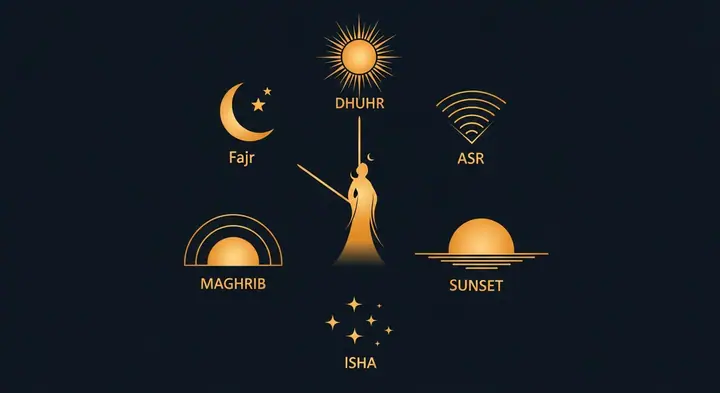
Five prayers. Five natural breaks in the day. Each tied to a specific point in the sun’s arc, meaning the schedule automatically adjusts with the seasons, with your location, with the rhythm of the natural world. Each prayer is preceded by the adhan — an audible call that marks the transition.
This is not coincidental. The Islamic prayer schedule was designed by the same Creator who made the human body, who built attention spans and fatigue curves and the need for regular resets into human physiology.
Modern research in productivity and cognitive science has independently arrived at many of the same conclusions: humans work best in focused blocks of 90–120 minutes, require regular intentional breaks, and benefit from physical transitions between work modes. The five prayers do all of this — and add a layer of meaning, spiritual connection, and divine blessing that no secular productivity system can offer.
The question for most Muslims today is not whether this system is good — it is how to actually live it.
Why Most Muslims Don’t Use Prayer as a Schedule
The honest answer is that most people’s lives are not organized around salah — salah is squeezed into a life organized around work, school, and social demands.
Prayers are delayed until the last possible moment, caught between meetings, rushed through in a parking lot, or sometimes missed entirely. Salah becomes reactive rather than structural.
This article is about the alternative: what it looks like to actually design your day around the prayers, and why that approach tends to produce both better deen and better productivity.
The Five Prayers as Five Time Blocks
Fajr — Block 0: The Protected Morning
Fajr prayer at dawn is the beginning of your day, not the alarm clock. Everything before Fajr is night; everything after is day.
When you pray Fajr and stay awake after it, you unlock the morning hours that the Prophet (peace be upon him) described as blessed. These hours — roughly from Fajr to mid-morning — are statistically your brain’s highest cognitive performance window (assuming adequate sleep).
What to do in the Fajr block:
- Fajr prayer + morning adhkar (20–30 minutes)
- Quran recitation (15–30 minutes)
- Your single most important task of the day (60–90 minutes)
- Light exercise or a walk
This block is non-negotiable time for high-value work. Protect it by not checking your phone until after it is complete.
The key discipline: Go to sleep early enough that Fajr is not painful. Most productive Muslims find that sleeping before 11pm makes Fajr feel completely different than sleeping at 1am.
Dhuhr — Block 1: The Midday Pivot
Dhuhr falls near the middle of the day, roughly around noon or 1pm depending on the season. It marks the moment the sun begins its descent.
By this time, you have had four to five hours of productive morning work. Cognitive fatigue is beginning to accumulate. Dhuhr is precisely timed for a reset.
The Dhuhr block:
- Stop what you are doing when the adhan sounds
- Perform wudu — the act of physical washing is itself a reset, a brief moment of mindfulness
- Pray Dhuhr (including the 4 sunnah before)
- Post-prayer adhkar
- Eat a moderate lunch
- If possible, a brief rest (qaylula)
Returning to work after Dhuhr, you enter what productivity experts call a “second wind” — a second block of focus that carries you to Asr.
What to do in the Dhuhr-to-Asr block:
- Administrative tasks, emails, meetings
- Work that requires communication rather than deep concentration
- Follow-ups and organizational tasks
Asr — Block 2: The Afternoon Checkpoint
Asr falls in the afternoon, roughly between 3 and 5pm depending on season and location. The Prophet (peace be upon him) specifically warned about neglecting Asr prayer: “Whoever misses the Asr prayer is as if he lost his family and wealth.” (Bukhari)
This strong emphasis reflects how easy it is to let the afternoon slip away. The middle of the afternoon is when meetings multiply, when procrastination peaks, when “one more task” becomes an excuse to delay prayer indefinitely.
Using Asr as a hard checkpoint solves this problem.
The Asr checkpoint practice:
- When the Asr adhan sounds, stop completely
- Review your list: What was the plan for today? What got done? What remains?
- Pray Asr + adhkar
- Make du’a in this window — between Asr and Maghrib, especially on Fridays, is a time of elevated du’a acceptance
After Asr, the day is winding down. The remaining time before Maghrib is best used for lower-stakes tasks, conversations, family time — not starting new deep work projects.
Maghrib — Block 3: The Day’s Close
Maghrib at sunset is the emotional close of the workday. The Prophet (peace be upon him) encouraged his family and household to be present and gathered at Maghrib time.
The time between Maghrib and Isha is one of the most underrated periods in the day. It is roughly 1–2 hours depending on the season, and it falls exactly when family members are home, children are finishing homework, and the pace naturally slows.
The Maghrib block:
- Pray Maghrib immediately when the adhan sounds
- Eat dinner with family if possible
- No screens during dinner
- Light reading, family conversation, reviewing the day
This block is for recovery and connection, not productivity. Treating it as an extension of the work day is one of the most common mistakes Muslims make — and one of the most costly for family relationships and spiritual wellbeing.
Isha — Block 4: The Spiritual Close
Isha marks the official end of the active day. The Prophet (peace be upon him) disliked sleeping before Isha and staying awake after it unnecessarily.
After Isha prayer, the ideal sequence is:
- Evening adhkar (Al-Mulk, the three Quls, Ayat al-Kursi)
- Minimal phone use
- Preparation for the next day (brief)
- Sleep at a reasonable hour
If you are someone who does their best creative thinking at night, using a limited window after Isha (one hour, maximum) for writing or creative work can be valuable — but it must be capped with a firm sleep time that protects Fajr.
Tahajjud (optional but transformative): Waking before Fajr for tahajjud prayer adds an extraordinary spiritual dimension to the day. Even two rak’ahs in the quiet of the night carries weight the Prophet (peace be upon him) described as unmatched. The person who maintains tahajjud regularly finds that their daytime hours carry a different quality.
Building the Salah-Centered Day: Practical Tips
Set alarm labels, not just times. Instead of “7:00 AM”, make your alarm say “Fajr — get up.” The label creates context and intention.
Protect the window before each prayer. The 10 minutes before salah are when you should be wrapping up, not beginning new tasks. Train yourself to treat the approaching adhan as a signal to close the loop on what you’re doing.
Use wudu as a transition ritual. Wudu before each prayer is a physical act of transition — washing away the previous mental state. Use it consciously. Don’t rush it.
Let Nafs handle the blocks automatically. Setting up screen time restrictions around prayer windows removes the need for willpower. When your phone blocks distracting apps for 20 minutes around each salah, you stop needing to decide — the decision is already made.
Start with one prayer. If your schedule is currently built around everything but salah, pick one prayer and design one block around it. Fajr is the most high-leverage. Begin there.
What This Looks Like in Practice
A Monday in a salah-centered day might look like this:
5:15am — Fajr, morning adhkar, Quran 6:00–8:00am — Deep work: writing, coding, creative work 8:00am — Breakfast, family 8:30–12:00pm — Work: meetings, email, collaboration 12:30pm — Dhuhr, lunch, rest 1:30–3:30pm — Focused work block 3:45pm — Asr, day review, du’a 4:00–5:30pm — Light tasks, calls, wrap-up 5:45pm — Maghrib, family dinner 7:00pm — Isha, evening adhkar 8:00pm — Reading, light conversation, preparation for next day 9:30pm — Sleep
This is not a rigid prescription. It is a frame — a structure that emerges when salah is truly the axis of the day rather than an item on the to-do list.
The Prophet (peace be upon him) said: “The coolness of my eyes has been placed in prayer.” When salah is your comfort, your anchor, and your joy — everything else in the day naturally orients around it.
Your five daily prayers are not interruptions to your day. They are the architecture that makes the rest of it possible.
Keep Reading
Start with the complete guide: The Productive Muslim’s Guide to Time & Attention
- Finding Barakah in Your Time: Islamic Productivity Secrets
- Time Wasters in Islam: What the Quran Says About Wasted Hours
- After Salah Adhkar: What to Say After Every Prayer
Ready to trade screen time for ibadah? Download Nafs free — 1 minute of worship = 1 minute of screen time.
Related Nafs guides
- See salah screen time app for connecting salah tracking with screen time habits.
Want to replace scrolling with ibadah?
Use Nafs to put worship before selected distracting apps and earn screen time through supported ibadah.
Download Nafs1 minute of ibadah = 1 minute of earned screen time.